
Why 3 Small Agents Beat 1 Big Model: The Economics of Autonomy
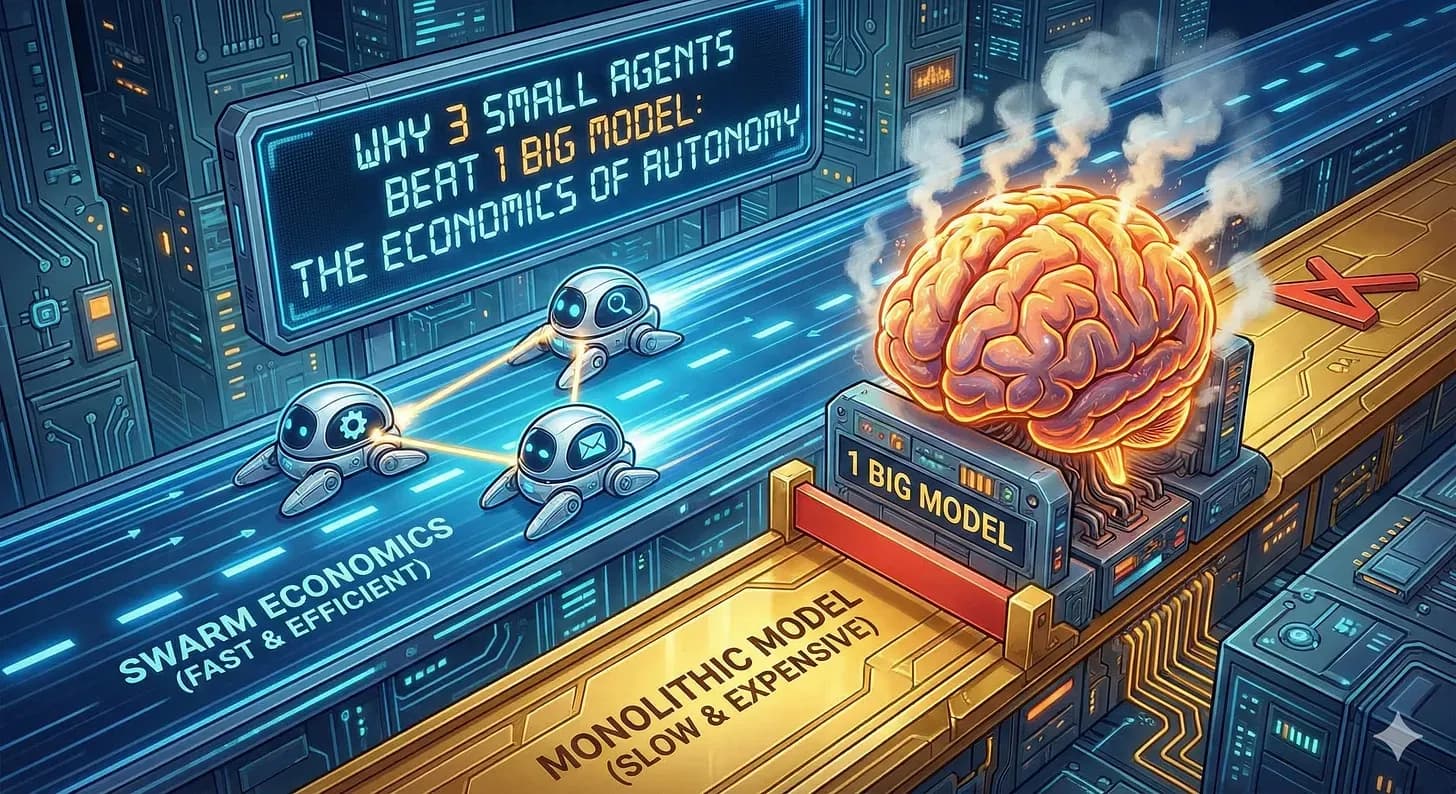
The “God Agent” Anti-Pattern
In software engineering, we learned decades ago that “God Objects”—classes that know too much, do too much, and touch everything—are a nightmare to maintain.
Yet, I see smart engineers building God Agents.
They write one massive System Prompt:
“You are an expert coder, QA tester, product manager, and documentation writer. Please read this ticket, write the code, test it, and update the docs.”
Then they wonder why the agent gets confused, forgets to run the tests, or hallucinates a library that doesn’t exist.
The problem isn’t the model. The problem is the context.
When you force a single agent to hold the context for coding, testing, and planning simultaneously, you are polluting its attention mechanism. The “needle” gets lost in the haystack of your instructions.
To build reliable autonomous systems, we need to apply the Single Responsibility Principle to AI.
We need to stop building Monoliths and start building Multi-Agent Microservices.
The Architecture of a Swarm
A Multi-Agent System (MAS) is not just “two agents talking.” It is a distributed system where State is the database and Natural Language is the API.
Here are the three architectural patterns I use to break down a Monolith into a functional Swarm.
Pattern 1: The Orchestrator (The Project Manager)
This is the most critical pattern for complex workflows. You do not let your “Coder Agent” talk to the user. You place a “Manager” in between.
The Role: The Orchestrator does no work. Its only job is Planning, Delegation, and Routing.
The Workflow:
- User: “Refactor
auth.pyto use OAuth2.” - Orchestrator: Breaks this down into steps (Plan) and routes the first task.
- The Routing Logic: This isn’t just LLM “vibes.” It requires deterministic routing logic to decide where the graph goes next.
The Code (Router Logic):
Python
def orchestrator_router(state: SwarmState):
"""The logic that decides the next node in the graph."""
last_message = state['messages'][-1]
# If the Code Agent says "I'm done", route to Critic
if last_message.tool_calls and last_message.tool_calls[0].name == "submit_code":
return "critic_agent"
# If the Critic says "Approved", route to Deployer
if "APPROVED" in last_message.content:
return "deploy_agent"
# Default: loop back or continue conversation
return "continue"
Why this wins: The CodingAgent never sees the user’s messy complaint. It only sees a clean, technical spec from the Orchestrator. Context pollution is eliminated.
Pattern 2: The Handoff (The Relay Race)
In a microservices architecture, Service A calls Service B via REST/gRPC. In an Agentic architecture, Agent A calls Agent B via Structured Handoff.
The biggest mistake I see is agents “chatting” with each other.
- Agent A: “Hey, can you help with this?”
- Agent B: “Sure, what do you need?”
This is waste. It costs tokens and adds latency.
The Fix: Standardized State Transfer (with Pydantic). You must enforce a strict contract. If Agent A wants to pass work to Agent B, it must conform to a schema.
The Code (The Contract):
Python
# Don't just prompt. Type-check.
from pydantic import BaseModel, Field
from typing import Literal
class AgentHandoff(BaseModel):
"""The strict contract for passing control between agents."""
source_agent: str
target_agent: Literal["coder", "reviewer", "security_audit"]
task_id: str
# Compressed context, stripping conversational fluff
context_summary: str = Field(..., description="Technical summary of work done so far.")
# The actual artifacts (code/files), not just text about them
artifacts: dict[str, str]
# If the LLM generates JSON that fails this schema,
# the orchestration layer rejects it automatically.
When Agent A finishes, it doesn’t “chat.” It dumps this object into the State.
“Agents shouldn’t have meetings. They should exchange memos.”
Pattern 3: The Critic (The Loop Breaker)
A single agent is terrible at checking its own work. If it made a logical error in the code, it will likely make the same error in the test.
You need an adversarial architecture.
The Setup:
- Agent A (Builder): “Here is the code.”
- Agent B (Critic): “I am reviewing this code. I found a security vulnerability in line 45. Reject.”
The Architecture: This is a while loop. while (Critic.status != "APPROVED" and retries < 5): Builder.fix(Critic.feedback)
This “Critic Loop” is the single biggest driver of code quality in autonomous systems. It turns a 60% success rate into a 90% success rate.
Managing State: The “Brain” of the Operation
In a monolith, state is easy (it’s in memory). In a swarm, state is hard. Where do the agents store their work?
If you are using frameworks like LangGraph, the “State” is a shared typed dictionary that acts as the single source of truth.
The Code (The State Schema):
Python
from typing import TypedDict, Annotated, List
import operator
class SwarmState(TypedDict):
# Append-only list of messages (standard chat history)
messages: Annotated[List[str], operator.add]
# The 'keys' to the car - who holds the token?
current_turn: str
# The structured artifacts (code, plans) - NOT in the chat history
# This prevents the context window from exploding with diffs
artifacts: dict[str, str]
# The error counter for the Circuit Breaker
retry_count: int
The Golden Rule of State: No agent owns the state. The System owns the state. Agents just borrow it.
The Tech Stack
You don’t need to build this from scratch. The tooling has matured.
- LangGraph: The industry standard for defining “State Machines.” It is perfect for the Orchestrator pattern because it forces you to define edges and nodes explicitly.
- CrewAI: Great for quickly spinning up “Role-Playing” swarms (e.g., “You are a Researcher,” “You are a Writer”).
- Pydantic: Essential. Never let an agent talk to another agent without validating the output schema with Pydantic first. If the JSON is broken, don’t pass it—fail fast.
Here is the revised, technically robust draft. I have integrated the code blocks to ground the concepts in actual implementation patterns.
Title: Stop Building Monoliths: A Blueprint for Multi-Agent Microservices Subtitle: Why the “God Agent” fails at scale, and how to architect the “Single Responsibility” swarm. Author: Sumant Thakur Date: January 2026
The “God Agent” Anti-Pattern
In software engineering, we learned decades ago that “God Objects”—classes that know too much, do too much, and touch everything—are a nightmare to maintain.
Yet, in 2026, I see smart engineers building God Agents.
They write one massive System Prompt:
“You are an expert coder, QA tester, product manager, and documentation writer. Please read this ticket, write the code, test it, and update the docs.”
Then they wonder why the agent gets confused, forgets to run the tests, or hallucinates a library that doesn’t exist.
The problem isn’t the model. The problem is the context.
When you force a single agent to hold the context for coding, testing, and planning simultaneously, you are polluting its attention mechanism. The “needle” gets lost in the haystack of your instructions.
To build reliable autonomous systems, we need to apply the Single Responsibility Principle to AI.
We need to stop building Monoliths and start building Multi-Agent Microservices.
The Architecture of a Swarm
A Multi-Agent System (MAS) is not just “two agents talking.” It is a distributed system where State is the database and Natural Language is the API.
Here are the three architectural patterns I use to break down a Monolith into a functional Swarm.
Pattern 1: The Orchestrator (The Project Manager)
This is the most critical pattern for complex workflows. You do not let your “Coder Agent” talk to the user. You place a “Manager” in between.
The Role: The Orchestrator does no work. Its only job is Planning, Delegation, and Routing.
The Workflow:
- User: “Refactor
auth.pyto use OAuth2.” - Orchestrator: Breaks this down into steps (Plan) and routes the first task.
- The Routing Logic: This isn’t just LLM “vibes.” It requires deterministic routing logic to decide where the graph goes next.
The Code (Router Logic):
Python
def orchestrator_router(state: SwarmState):
"""The logic that decides the next node in the graph."""
last_message = state['messages'][-1]
# If the Code Agent says "I'm done", route to Critic
if last_message.tool_calls and last_message.tool_calls[0].name == "submit_code":
return "critic_agent"
# If the Critic says "Approved", route to Deployer
if "APPROVED" in last_message.content:
return "deploy_agent"
# Default: loop back or continue conversation
return "continue"
Why this wins: The CodingAgent never sees the user’s messy complaint. It only sees a clean, technical spec from the Orchestrator. Context pollution is eliminated.
Pattern 2: The Handoff (The Relay Race)
In a microservices architecture, Service A calls Service B via REST/gRPC. In an Agentic architecture, Agent A calls Agent B via Structured Handoff.
The biggest mistake I see is agents “chatting” with each other.
- Agent A: “Hey, can you help with this?”
- Agent B: “Sure, what do you need?”
This is waste. It costs tokens and adds latency.
The Fix: Standardized State Transfer (with Pydantic). You must enforce a strict contract. If Agent A wants to pass work to Agent B, it must conform to a schema.
The Code (The Contract):
Python
# Don't just prompt. Type-check.
from pydantic import BaseModel, Field
from typing import Literal
class AgentHandoff(BaseModel):
"""The strict contract for passing control between agents."""
source_agent: str
target_agent: Literal["coder", "reviewer", "security_audit"]
task_id: str
# Compressed context, stripping conversational fluff
context_summary: str = Field(..., description="Technical summary of work done so far.")
# The actual artifacts (code/files), not just text about them
artifacts: dict[str, str]
# If the LLM generates JSON that fails this schema,
# the orchestration layer rejects it automatically.
When Agent A finishes, it doesn’t “chat.” It dumps this object into the State.
“Agents shouldn’t have meetings. They should exchange memos.”
Pattern 3: The Critic (The Loop Breaker)
A single agent is terrible at checking its own work. If it made a logical error in the code, it will likely make the same error in the test.
You need an adversarial architecture.
The Setup:
- Agent A (Builder): “Here is the code.”
- Agent B (Critic): “I am reviewing this code. I found a security vulnerability in line 45. Reject.”
The Architecture: This is a while loop. while (Critic.status != "APPROVED" and retries < 5): Builder.fix(Critic.feedback)
This “Critic Loop” is the single biggest driver of code quality in autonomous systems. It turns a 60% success rate into a 90% success rate.
Managing State: The “Brain” of the Operation
In a monolith, state is easy (it’s in memory). In a swarm, state is hard. Where do the agents store their work?
If you are using frameworks like LangGraph (which I highly recommend), the “State” is a shared typed dictionary that acts as the single source of truth.
The Code (The State Schema):
Python
from typing import TypedDict, Annotated, List
import operator
class SwarmState(TypedDict):
# Append-only list of messages (standard chat history)
messages: Annotated[List[str], operator.add]
# The 'keys' to the car - who holds the token?
current_turn: str
# The structured artifacts (code, plans) - NOT in the chat history
# This prevents the context window from exploding with diffs
artifacts: dict[str, str]
# The error counter for the Circuit Breaker
retry_count: int
The Golden Rule of State: No agent owns the state. The System owns the state. Agents just borrow it.
The Tech Stack
You don’t need to build this from scratch. The tooling has matured.
- LangGraph: The industry standard for defining “State Machines.” It is perfect for the Orchestrator pattern because it forces you to define edges and nodes explicitly.
- CrewAI: Great for quickly spinning up “Role-Playing” swarms (e.g., “You are a Researcher,” “You are a Writer”).
- Pydantic: Essential. Never let an agent talk to another agent without validating the output schema with Pydantic first. If the JSON is broken, don’t pass it—fail fast.
Conclusion: Composition over Size
We used to think “Bigger Model = Better Agent.” In 2026, we know that “Better Architecture = Better Agent.”
A team of three GPT-4o-mini agents, orchestrated well, will outperform a single GPT-5 prompt every single time.
"A team of three small agents, orchestrated well, will outperform a single massive model every time."
Stop trying to prompt your way out of an architecture problem. Break it down. Assign roles. Build the swarm.