
Inside Flurit AI: The Multi-Agent Engine Rewriting How DevOps Gets Done
Why we built an orchestrated team of AI agents to plan, validate, and safeguard modern infrastructure workflows.
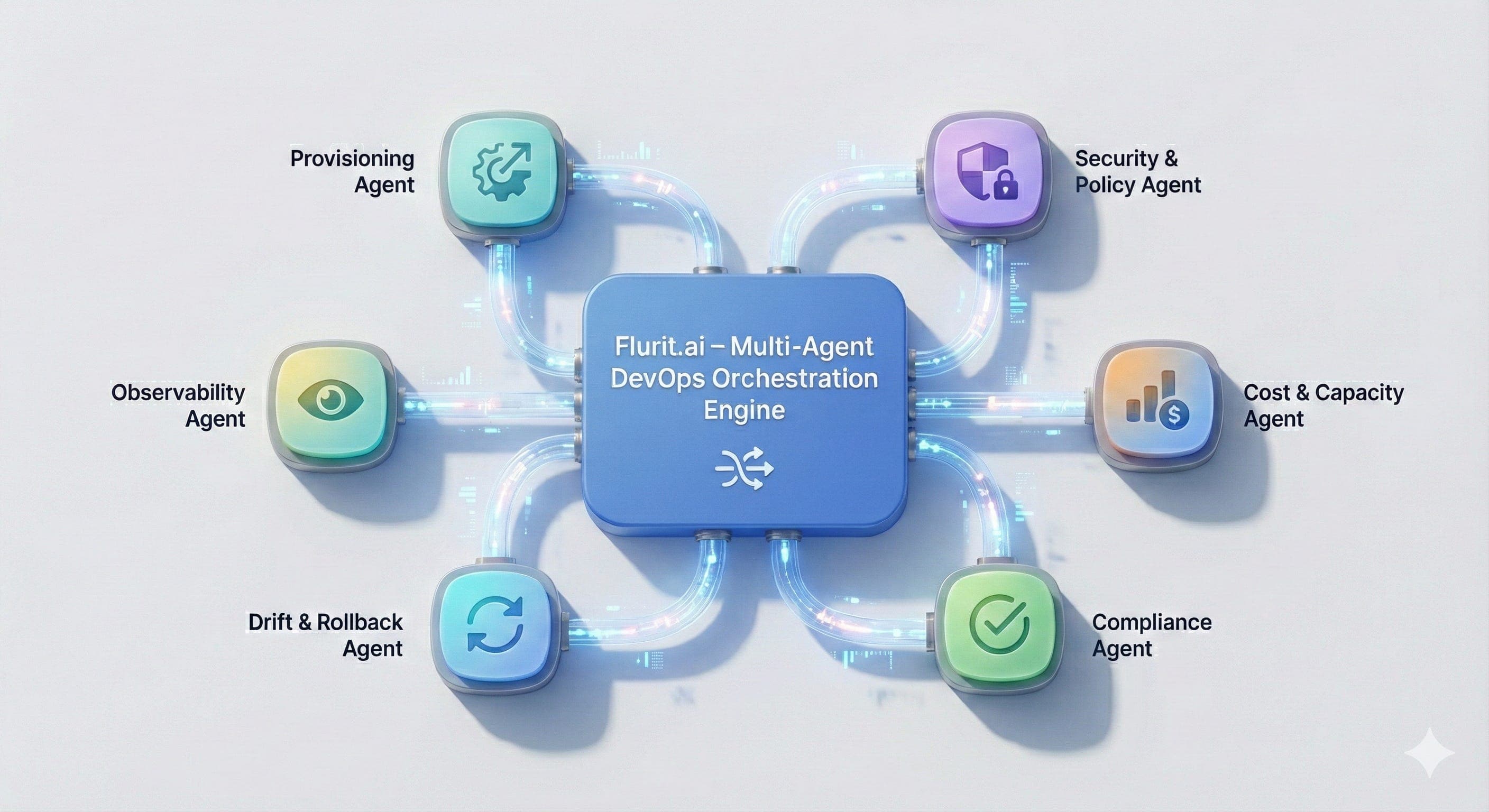
When I started working on Flurit AI, I wasn’t trying to build a multi-agent orchestration system.
I wasn’t even thinking about “agents” or “orchestration” or “AI-driven infra reasoning.”
My first goal was much simpler:
Help engineers deploy infrastructure without fear.
Fear of breaking IAM.
Fear of causing downtime.
Fear of compliance drift.
Fear of cost spikes.
Fear of touching Terraform even when it desperately needed updates.
But as I went deeper into the problem, something became obvious:
No single script.
No single pipeline.
No single AI assistant.
No single abstraction layer.
Not even a “super smart LLM” could solve DevOps complexity in isolation.
What we needed was coordination — not code generation.
We needed reasoning — not snippets.
We needed autonomous and specialized units that could collaborate.
We needed a system that could behave like a team, not a tool.
That realization is what eventually led to Flurit AI’s multi-agent orchestration engine.
This post is a breakdown of how we got here, why this architecture works, and what it means for the future of DevOps.
1. The early experiments: why “single LLM agent” wasn’t enough
The first prototypes of Flurit AI were embarrassingly simple.
A single LLM took user intent and produced IaC suggestions.
It was useful… until it wasn’t.
We repeatedly hit the same limitations:
a. No single agent can understand the entire infrastructure universe
A single model trying to:
- write Terraform
- enforce IAM
- plan network topology
- optimize cost
- validate compliance
- ensure rollout safety
- configure monitoring
- inspect blast radius
…was doomed.
It’s the equivalent of asking one engineer to be a DevOps specialist, security expert, network architect, SRE, FinOps analyst, policy engine, and deployment strategist simultaneously.
b. Failure modes were dangerous
Single-agent systems hallucinate silently.
One wrong assumption from the model → one wrong Terraform block → one catastrophic change in IAM → one production outage.
We saw too many near-misses.
c. There was no separation of concerns
Infrastructure is not “one task.”
It is a multi-domain system, each with its own rules and constraints.
Trying to compress everything into one model created brittle and unpredictable behavior.
This was the moment we realized:
The future is not one agent. The future is many.
2. The insight: DevOps itself is a multi-agent workflow
If you observe high-functioning platform teams, they operate like a multi-agent system:
- One engineer reviews security
- One checks cost
- One validates Terraform
- One monitors performance
- One manages rollout safety
- One ensures compliance
Each has a specialization.
They collaborate.
They negotiate.
They challenge each other.
They reach consensus.
And they escalate to humans when unsure.
This pattern is exactly what an AI-driven system should replicate.
That was our architectural turning point:
**Flurit AI would not be a “single AI doing everything.”
It would be a coordinated team of specialized agents working under a shared orchestrator.**
3. The orchestrator: the brain of Flurit AI
The orchestrator is not a single model.
It is a control plane that:
- interprets user intent
- creates a structured plan
- delegates tasks to the correct agents
- merges results and resolves conflicts
- enforces sequencing, dependencies, and safety
- decides when to escalate to human approval
Think of it as a senior platform architect.
It does not write every line of code itself.
It coordinates the team that does.
Some examples:
- If a provisioning plan violates a security policy → orchestration halts → security agent blocks → user is warned.
- If a network mapping triggers cost anomalies → orchestrator reroutes to cost agent for optimization.
- If deployment fails validation → orchestrator initiates rollback via drift agent.
The orchestrator is where reasoning happens.
The agents are where execution happens.
4. The agents: why specialization matters
Each agent in Flurit AI is built around three principles:
1. Deep domain understanding
Example:
The Security Agent doesn’t just “check IAM.”
It knows:
- privilege boundaries
- resource scoping
- least privilege patterns
- common escalation mistakes
- compliance-sensitive policies
- identity-graph relationships
Likewise:
- Cost Agent understands pricing models, SKU differences, resource scaling, billing anomalies.
- Observability Agent understands dashboards, logs vs metrics, SLO vs alerting design.
- Drift Agent can detect unapproved resource changes and propose remediation.
2. Deterministic behavior
LLMs generate ideas.
Agents generate decisions + steps.
Every agent must produce:
- structured reasoning
- structured output
- verifiable results
We enforce deterministic templates for all agents to avoid hallucination drift.
3. Safe tool execution
Agents do not run bash commands directly.
Instead, they:
- generate a plan
- run validations
- request orchestrator approval
- pass through the validation engine
- only then can invoke tools or IaC
This adds predictability and safety.
5. The validation engine: where Flurit AI becomes production-safe
Every change — regardless of which agent proposes it — flows through a central validator.
It performs checks across:
- security
- cost
- compliance
- dependency topology
- blast radius
- network reachability
- data sensitivity
- drift analysis
- rollback feasibility
If anything seems off:
- orchestrator halts
- validator flags the risk
- human review is required
This is how we prevent “AI gone rogue.”
6. Human-in-the-loop: the non-negotiable layer
Flurit AI is not designed to replace DevOps engineers.
It is designed to amplify them.
That’s why critical workflows require human review:
- IAM
- networking
- production deployments
- compliance-sensitive infra
- high-risk configuration changes
Instead of flooding engineers with manual work, Flurit AI brings them:
- curated diffs
- blast-radius summaries
- side-by-side comparisons
- policy violations
- cost forecasts
- rollback plans
Humans don’t do grunt work.
Humans do judgment work.
AI does the orchestration.
7. Lessons learned building a multi-agent system
Flurit AI’s architecture wasn’t obvious at first.
We learned painful lessons along the way:
1. Single-agent systems become unmanageable fast
One model trying to do everything → unpredictable, unsafe behavior.
2. Tool calling must be structured and deterministic
Natural language → shell commands is terrifying.
We enforce typed tool schemas, typed arguments, and strict guardrails.
3. “Explainability first” is the only path to trust
Agents must show:
- what they changed
- why they changed it
- what risks exist
- what alternatives they considered
4. Multi-agent negotiation is powerful
Security agent and provisioning agent sometimes disagree.
This is good.
This is where safety emerges.
5. Humans must remain final authority
Autonomous infra can be built.
But safe infra requires collaborative autonomy.
8. Why this architecture matters for the future of DevOps
DevOps is no longer a human-scale problem.
Not because engineers are incapable —
but because infrastructure complexity has grown beyond individual cognitive capacity.
Today, managing infra requires simultaneous reasoning across:
- cloud platforms
- IaC
- networking
- identity graphs
- cost models
- logs and metrics
- compliance frameworks
- data locality
- deployment rollout patterns
- failover strategies
- security policies
This is not a “tool problem.”
It is a coordination problem.
A single engineer cannot hold the entire dependency graph in mind.
A single AI model cannot reason across all domains reliably.
A multi-agent system, with strong governance, can.
This architecture is not hype.
It is inevitable.
Infrastructure is outgrowing traditional DevOps.
Agentic orchestration — the thing we are building at Flurit AI — is the natural successor.